
Edge cache overrides
Cache overrides steer the edge response cache for the requests you choose: force a caching policy onto an origin that does not send one, or bypass the cache for paths that must never be stored. Each override has a filter expression and an action — cache or bypass.
The edge cache is honor-origin by default: it caches a response only when
your origin opts in with explicit Cache-Control / Expires freshness, and it
never invents a TTL. That’s the safe default, but it leaves two gaps you can’t
always close from the origin — an origin you don’t control (or one that forgot
its cache headers) is permanently uncacheable, and an origin that over-shares
(cacheable headers on a per-user path) can’t be fenced off without a redeploy.
Cache overrides are the edge’s escape hatch for both.
The Cache page#
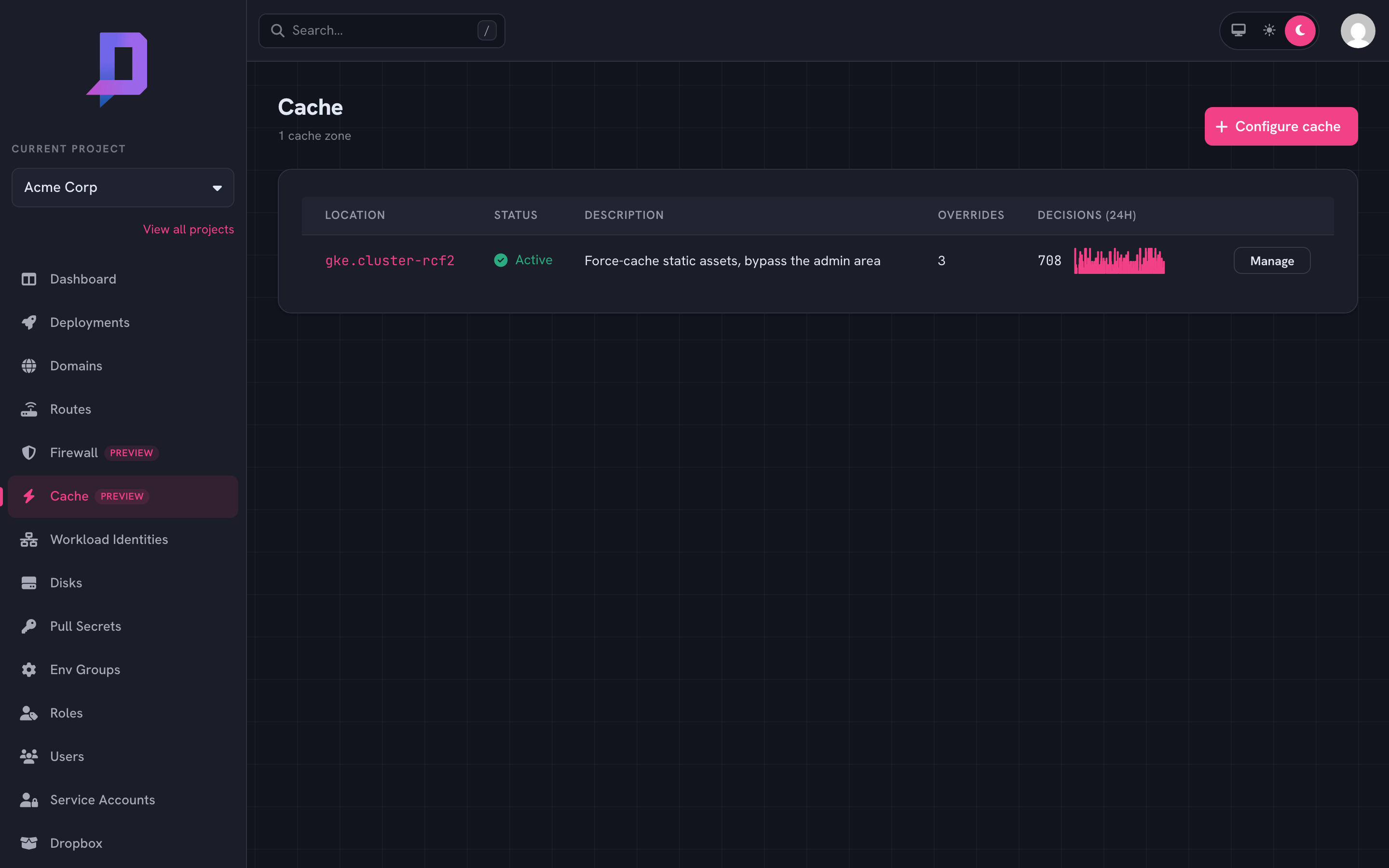
The Cache tab lists every zone in the project (one per location), with its status, override count, and a 24-hour decision sparkline so you can see how busy the overrides have been.
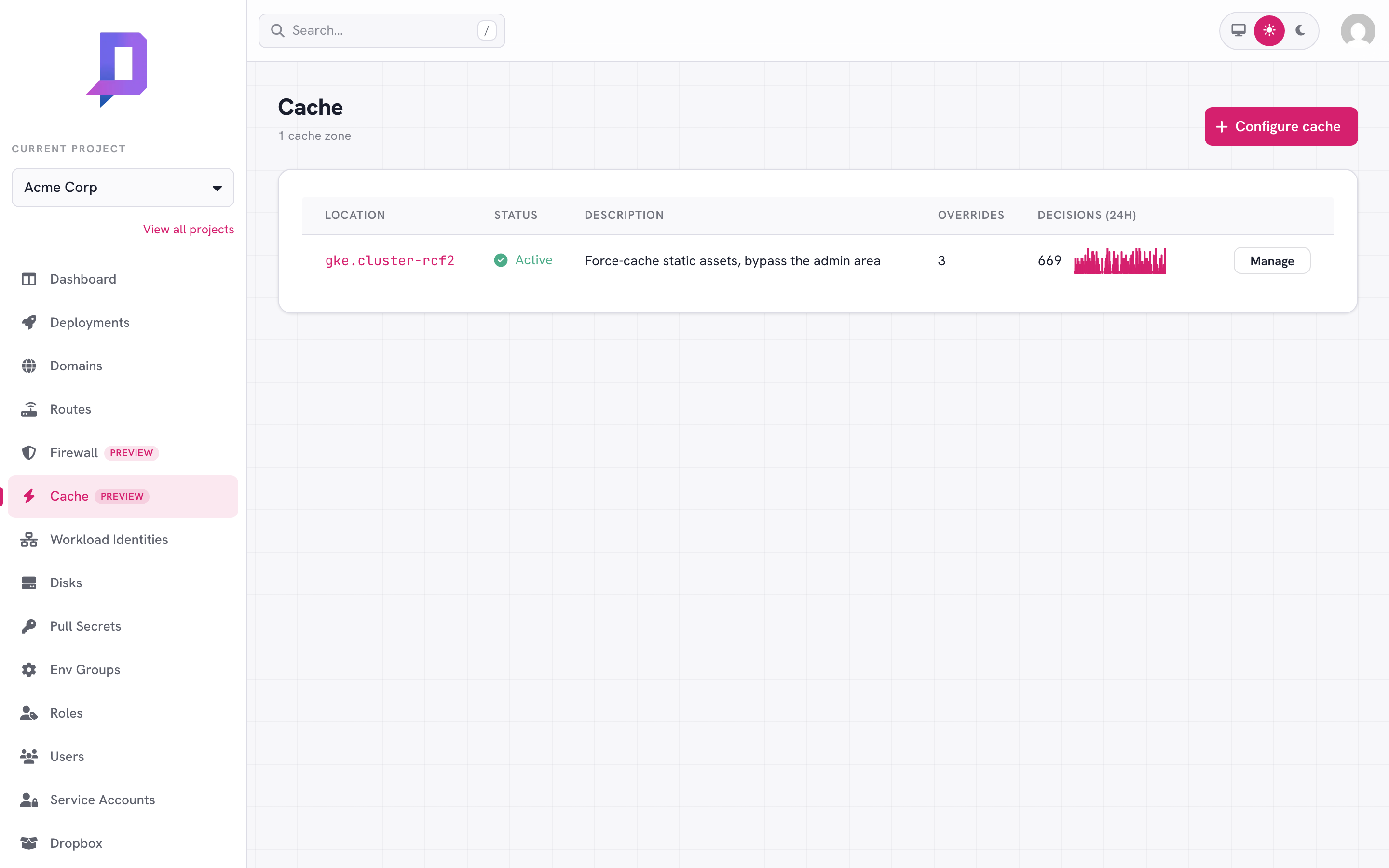
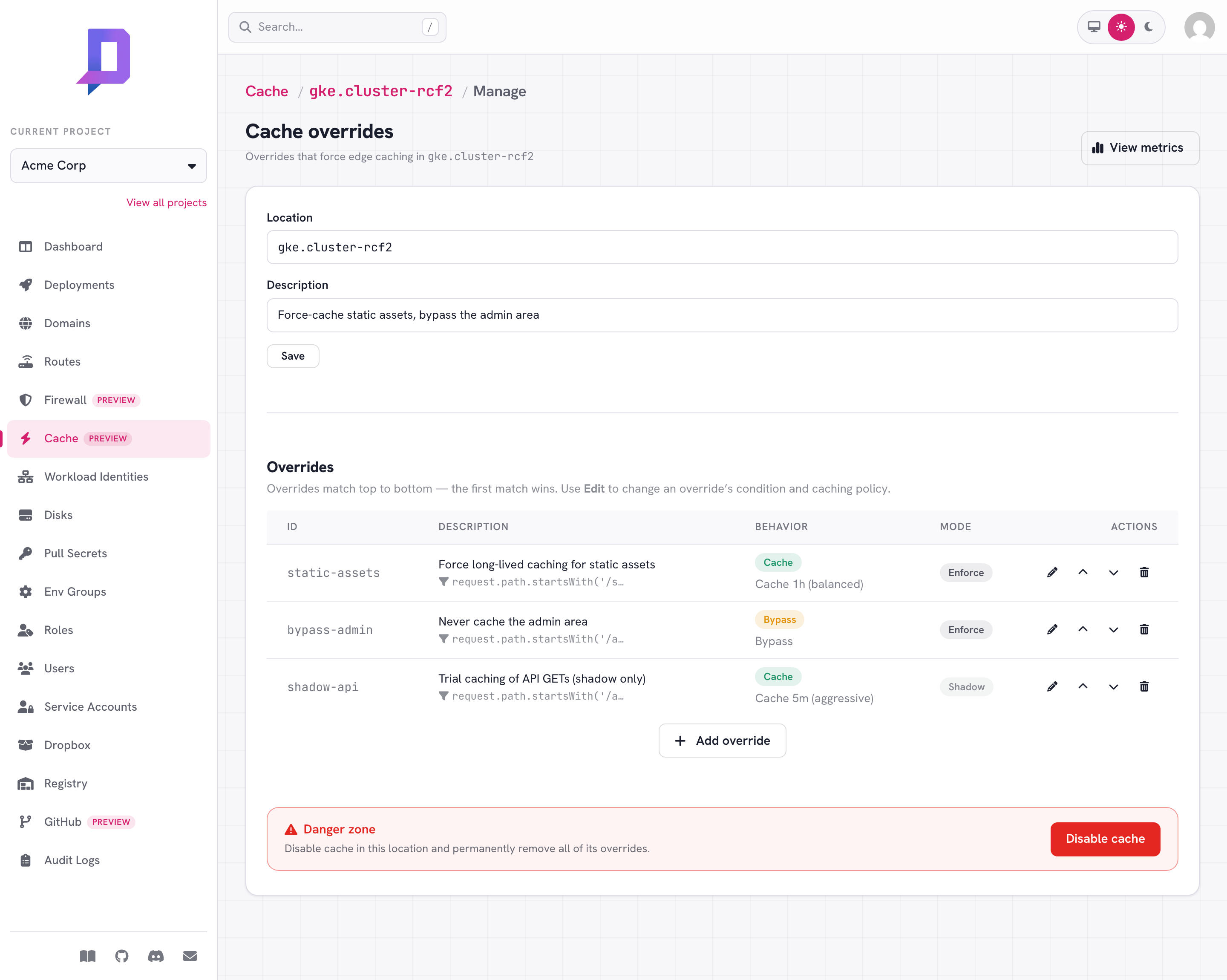
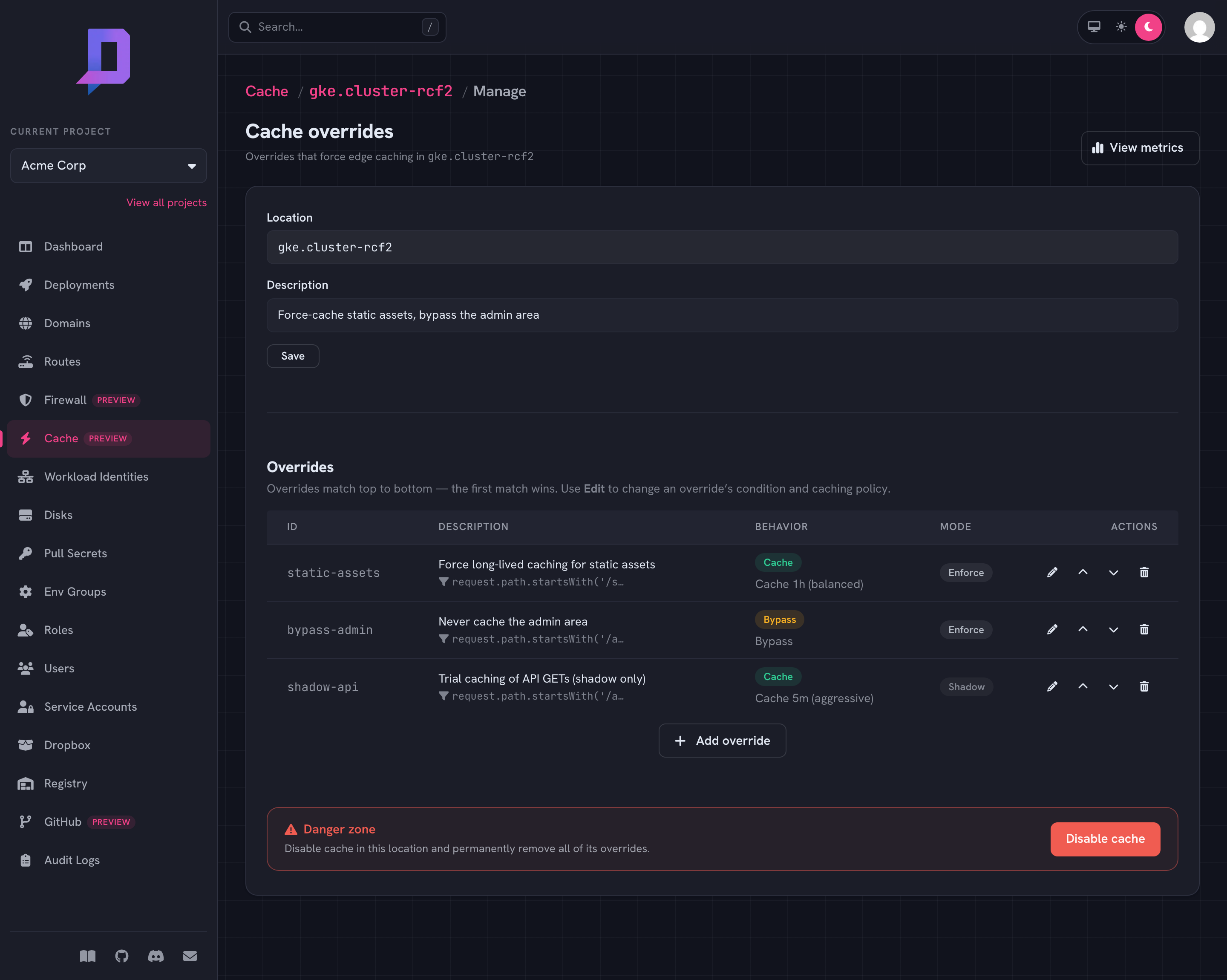
Click Manage to view, reorder, and edit the zone’s overrides.
How overrides work#
Overrides match in priority order — top to bottom in the table. For caching decisions the first matching override wins; a request that matches none is handled by the honor-origin default.
| Action | Effect |
|---|---|
cache | Force a caching policy onto the response — store it at the edge for the override’s TTL, even if the origin didn’t ask for it. |
bypass | Skip the cache entirely for matching requests — always go to the origin, never store the response. A bypass always wins over a cache force. |
A cache override is described by a few fields:
{
  "id": "static-assets",
  "description": "Force long-lived caching for static assets",
  "action": "cache",
  "filter": "request.path.startsWith('/static/')",
  "ttl": "1h",
  "policy": "balanced",
  "staleWhileRevalidate": "30s",
  "status": [200],
  "mode": "enforce",
  "priority": 0
}
ttl— the forced freshness lifetime (a Go duration,1s..720h). Required forcache; not used forbypass.policy— how far the force reaches over the origin’sCache-Control:conservative— only fill in missing freshness.balanced(default) — force, but refuse to cache responses that look unsafe to share.aggressive— override almost everything.
staleWhileRevalidate/staleIfError— optional RFC 5861 windows: serve a stale response while revalidating in the background, or when the origin errors.status— optional; force only these origin response statuses (e.g.[200, 301]). Empty forces every cacheable status.priority— orders thecacherules against each other; the lowest number wins and declaration order breaks ties.0resolves to the default (100).bypassrules aren’t ordered — a matching bypass always wins.mode—enforce(default) applies the override;shadowevaluates and counts it without changing caching. See Roll out safely.
The filter expression#
Override filters use the same expression language as the Firewall —
small boolean expressions over request.path, request.method,
request.host, request.headers['name'], and the rest. An empty filter applies
the override to every request.
request.path.startsWith('/static/')
request.path.startsWith('/api/') && request.method == 'GET'
request.host == 'cdn.example.com'
One difference from the Firewall: request.body is always empty in a cache
filter — caching decisions run before the request body is read.
Roll out safely#
aggressive can leak between users. It overrides the Authorization gate,
so an aggressive force on a per-user or authenticated path can cache one user’s
response and serve it to another. Reserve aggressive for responses you are
certain are identical for everyone, and prefer scoping the filter tightly.Trial a force in shadow mode first. Set mode: shadow and the override is
evaluated and counted on the metrics page but never actually changes caching.
Watch the shadow decisions for a day to confirm the filter matches what you
expect, then flip it to enforce.
priority 0 — cache  — request.path.startsWith('/static/')  ttl 1h   (enforce)
priority 1 — bypass — request.path.startsWith('/admin')             (enforce)
priority 2 — cache  — request.path.startsWith('/api/')     ttl 5m   (shadow)
Metrics#
The Cache metrics page plots decisions per result — applied, shadow, and error — over a selectable window (1h, 6h, 12h, 1d, 7d, 30d), with a per-override breakdown so you can size a shadow override before enforcing it and spot an override that suddenly starts (or stops) matching traffic.
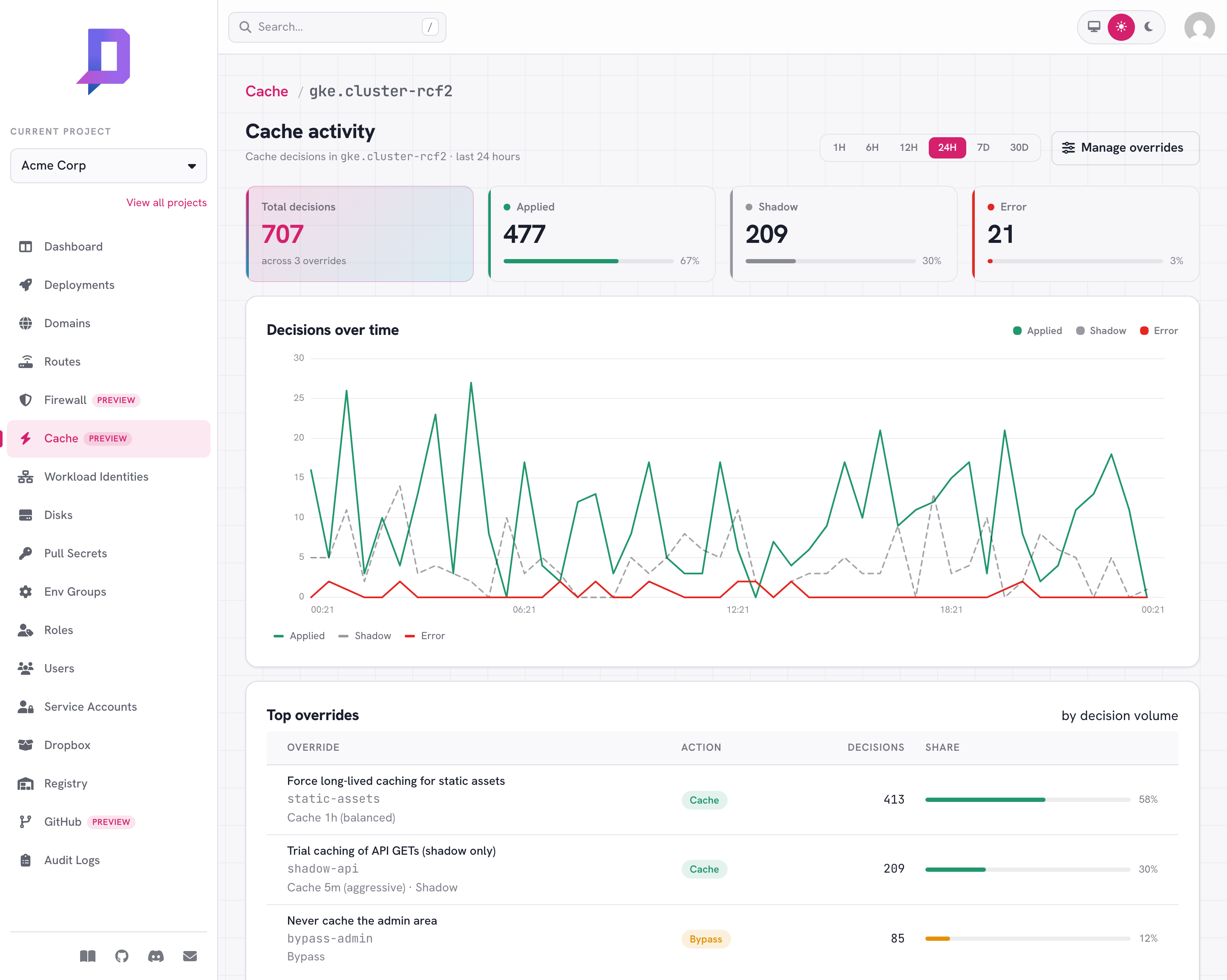
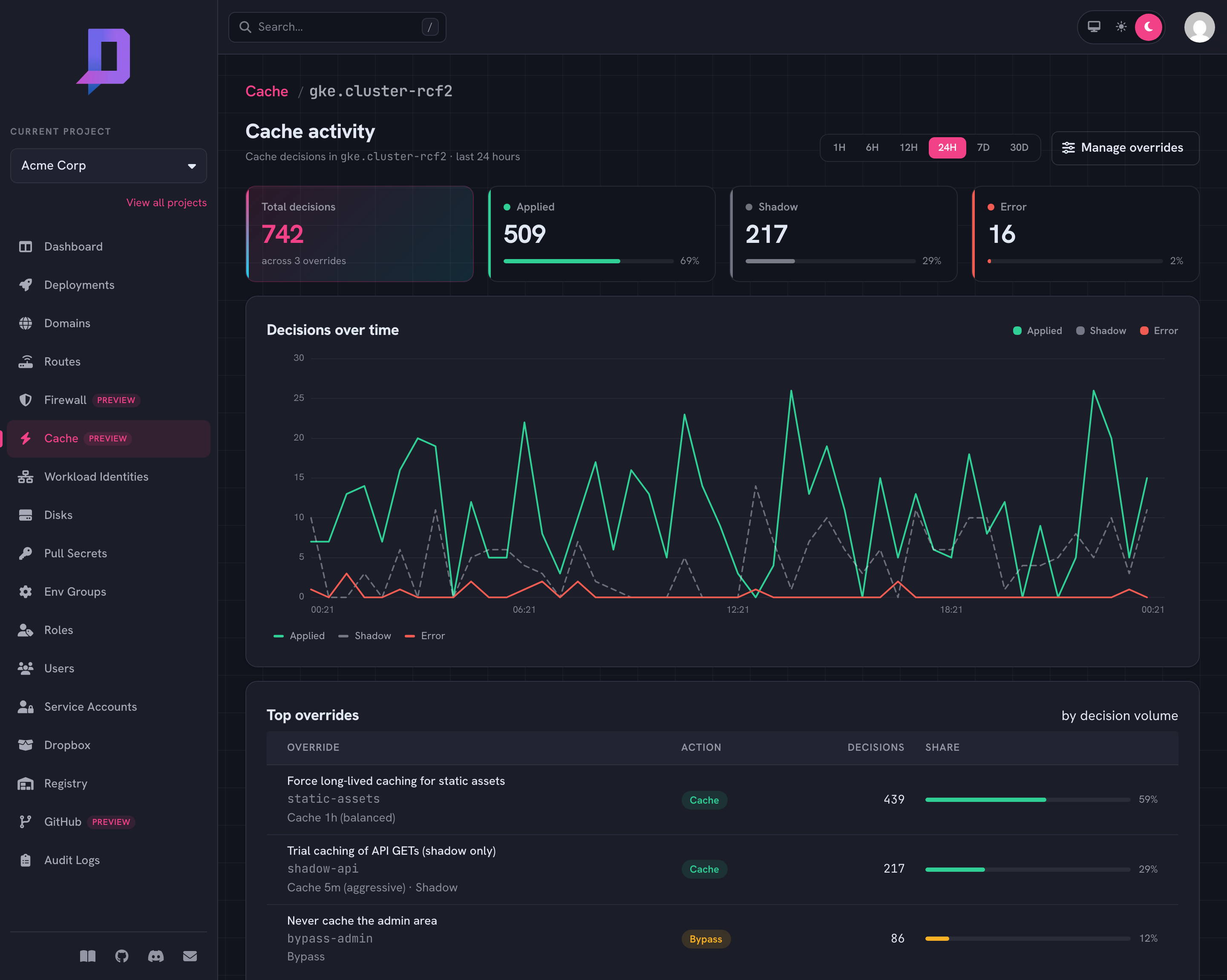
The same data is available via the API:
curl https://api.deploys.app/cache.metrics \
  -H "Authorization: Bearer $DEPLOYS_TOKEN" \
  -d '{ "project": "acme", "location": "gke.cluster-rcf2",
        "timeRange": "1d" }'