
Roles & permissions
A role names a set of permissions. To grant access you create a role, bind it to a user or service account, and the platform checks the permission on every API call.
The Roles page#
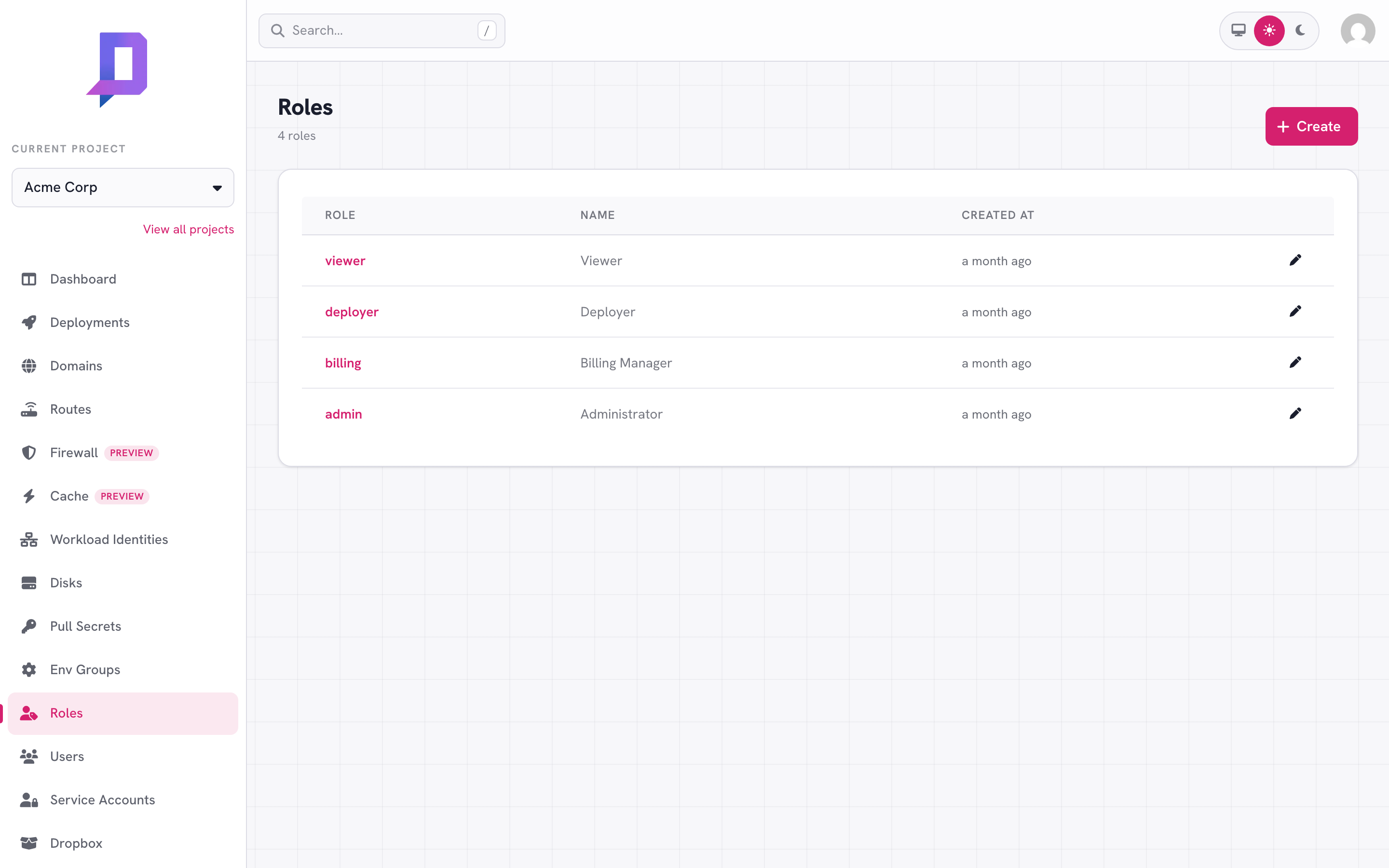
The Roles tab lists every role in the project — built-in (viewer, admin)
and any you’ve defined.
Built-in roles#
viewer— read-only across the project. Members can list and get every resource type but can’t change anything.admin— full control. The single permission*covers everything, including granting other people roles.
These exist by default — you can’t delete them.
Custom roles#
Create a role with the exact permissions you want:
deploys role create \
  --project acme \
  --role deployer \
  --name "Deployer" \
  --permissions "project.get,deployment.list,deployment.get,deployment.deploy,registry.list"
The --permissions flag takes a comma-separated list of permission strings.
A permission is <namespace>.<action>, and unlike the API function names it is
always lowercase — the serviceaccount.createKey call, for example, is
guarded by the serviceaccount.key.create permission. Matching is exact, so the
casing matters: serviceaccount.createKey in a role grants nothing. The
authoritative list is whatever role.permissions returns; the most useful ones:
| Group | Permissions |
|---|---|
| Project | project.get, project.delete |
| Deployment | deployment.list, deployment.get, deployment.deploy, deployment.delete |
| Domain | domain.list, domain.get, domain.create, domain.delete, domain.purgecache |
| Route | route.list, route.get, route.create, route.delete |
| Firewall (WAF) | waf.list, waf.get, waf.set, waf.delete |
| Cache | cache.list, cache.get, cache.set, cache.delete |
| Disk | disk.list, disk.get, disk.create, disk.update, disk.delete |
| Registry | registry.list, registry.get, registry.pull, registry.push |
| Pull secret | pullsecret.list, pullsecret.get, pullsecret.create, pullsecret.delete |
| Env group | envgroup.list, envgroup.get, envgroup.create, envgroup.update, envgroup.delete |
| Workload identity | workloadidentity.list, workloadidentity.get, workloadidentity.create, workloadidentity.delete |
| Service account | serviceaccount.list, serviceaccount.get, serviceaccount.create, serviceaccount.delete, serviceaccount.key.create, serviceaccount.key.delete |
| Role | role.list, role.get, role.create, role.delete, role.bind |
| GitHub | github.list, github.link, github.unlink, github.update |
email.list, email.send | |
| Dropbox | dropbox.list, dropbox.upload |
| Static sites | site.publish |
| Audit | auditlog.list |
Some actions don’t have their own permission — they ride on a broader one.
deployment.metrics, deployment.revisions, deployment.rollback,
deployment.pause, and deployment.resume are all covered by deployment.get
or deployment.deploy; registry.delete / deleteManifest / untag are
covered by registry.push; project.usage and project.metrics by
project.get. Granting the made-up string does nothing — grant the broader
permission instead.
.list and .get differ in what data they return, not just scope:
deployment.list is a non-sensitive index — it returns each deployment’s name,
type, status, image and other metadata, but never the environment
variables, mounted files, command/args, annotations, or the signed log URLs.
Those require deployment.get. Likewise envgroup.list returns only the group
names and a variable count, while the values require envgroup.get. So a role
with deployment.list/envgroup.list but not the matching .get can enumerate
deployments and env groups without reading any secret — a useful split for
dashboards, inventory tooling, or a CI step that only needs to know what exists.
The wildcard * matches everything, and each namespace has a <namespace>.*
(for example domain.*) covering that namespace’s actions.
Billing access isn’t a project permission: billing calls are authorized by the billing account — its owner and any members you invite — not by a role in the project.
Binding roles#
Bind a role to a user by email, or to a service account by email:
# add a role to someone
deploys role grant \
  --project acme --role deployer \
  --email engineer@acme.dev

# bind a user to a list of roles in one call (replaces their current set)
deploys role bind \
  --project acme \
  --email engineer@acme.dev \
  --roles "deployer,billing"

# revoke a single role
deploys role revoke \
  --project acme --role admin --email old-admin@acme.dev
A person who has been granted access for the first time gets an email invite.
Once they sign in, the next role.users call shows their email under the
project.
Listing who has what#
deploys role users --project acme
Returns every email bound to the project with the role IDs they hold. Useful for periodic audits — pipe it into a script, diff against an expected list, alert on drift.
Permission resolution#
Permissions are additive: if any role bound to a principal grants the permission, the call succeeds. There’s no explicit deny. To remove a permission, remove the role that grants it.
The audit log records permission denials too — failed calls show up with
outcome: forbidden.
Patterns#
- Deployer for CI, restricted to
deployment.deployand the read calls needed to inspect status. CI never needs to manage roles or delete projects. - Viewer for the on-call rotation, plus
auditlog.listif you want them to debug without changing anything. (Viewer already hasdeployment.get, which covers metrics and revisions.) - Operator with everything except
project.delete,role.bind, andserviceaccount.key.create. Day-to-day powerful, but can’t change who has access or generate new machine credentials.
Keep admin to the smallest practical group; everyone else gets a tailored
role.